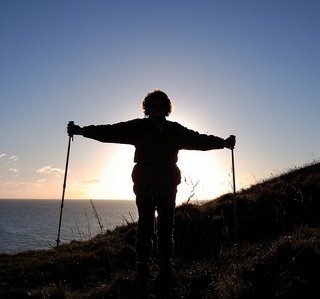
Ages: Colin was 63 years and 30 days. Rosemary was 60 years and 172 days.
Weather: Hot and sunny with a cool breeze.
Location: Pyewipe to North Killingholme Haven, via Immingham.
Distance: 10½ miles.
Total distance: 868 miles.
Terrain: Concrete sea walls and the verges of busy roads. Flat.
Tide: Going out.
Rivers: None.
Ferries: None.
Piers: None.
Kissing gates: None.
Pubs: None.
‘English Heritage’ properties: None.
Ferris wheels: None.
Diversions: None.
How we got there and back: We were camping at Barton-upon-Humber. We drove, with bikes on the back of the car, to North Killingholme Haven where, with no argument at all, we parked just off the road leading to the jetty with heavy lorries rumbling past every minute or so. Then we cycled our Walk in reverse, all the way to the edge of the Pyewipe industrial estate at Great Coates. At one point we missed the footpath, and ended up coming out of a gateway which threatened us with extermination should we even think of trespassing on their land—lots of workmen had seen us pedalling by and not one had taken any notice of us!
At the end, we had a cup of tea. Then we drove round by road to collect our bikes—and back to our campsite along main roads because it was quicker.

 By the time we arrived at our starting point and had locked up the bikes, we were so hungry we sat amongst the daisies on the corner of this huge industrial estate and ate our pork pies. Then we walked along a road with humps to the waterfront. We were passed by several cyclists travelling in each direction, we think the locals use the waterfront route for getting about in preference to the local lanes which are full of heavy lorries rushing along at speed. We mused about the fact that we could easily have parked along the humpy road yesterday—it was wide enough and would have meant we didn’t have to walk out of our way.

 Today’s Walk was all heavy industry. We knew it would be bad after looking at the map, so we decided to be positive and look out for wildlife along the way. We saw some lovely flowers (weeds?), and on the mudflats of the Humber Estuary we saw oystercatchers, shelducks, gulls, a moorhen, a coot and a heron. We also spied lots of colourful burnet moths, swallows, a goldfinch, a linnet, curlews, rabbits, a crow (which I managed to photograph), a magpie, a lapwing and starlings. At the very end of the Walk we saw a swan, but the picture I took of it was so out of focus I dumped it.
  We went into ecstasies when a hairy caterpillar crossed our path (we were only kidding ourselves) but I must add that we also saw a rat!
 In fact today’s Walk was horrible! It was mostly along a concrete sea wall past factories with gruesome warning notices. I mean, if we had seen flashing lights and heard wailing sirens, where would we have gone? Certainly not over the fence into the factory complex, nor over the seawall on to the mudflats where we would have surely drowned in the quicksands. We could only have continued along the narrow path we were on or go back the way we had come—fortunately we didn’t have to make the decision! We didn’t like the colour of the smoke we could see emanating from factory chimneys, and some of the smells we experienced were noxious to say the least.
  We moved on quickly. We could see the other side of the estuary more clearly today, but it didn’t exactly fill us with inspiration. Flat and featureless were words that came to mind.

 By the time we arrived at our starting point and had locked up the bikes, we were so hungry we sat amongst the daisies on the corner of this huge industrial estate and ate our pork pies. Then we walked along a road with humps to the waterfront. We were passed by several cyclists travelling in each direction, we think the locals use the waterfront route for getting about in preference to the local lanes which are full of heavy lorries rushing along at speed. We mused about the fact that we could easily have parked along the humpy road yesterday—it was wide enough and would have meant we didn’t have to walk out of our way.

 Today’s Walk was all heavy industry. We knew it would be bad after looking at the map, so we decided to be positive and look out for wildlife along the way. We saw some lovely flowers (weeds?), and on the mudflats of the Humber Estuary we saw oystercatchers, shelducks, gulls, a moorhen, a coot and a heron. We also spied lots of colourful burnet moths, swallows, a goldfinch, a linnet, curlews, rabbits, a crow (which I managed to photograph), a magpie, a lapwing and starlings. At the very end of the Walk we saw a swan, but the picture I took of it was so out of focus I dumped it.
  We went into ecstasies when a hairy caterpillar crossed our path (we were only kidding ourselves) but I must add that we also saw a rat!
 In fact today’s Walk was horrible! It was mostly along a concrete sea wall past factories with gruesome warning notices. I mean, if we had seen flashing lights and heard wailing sirens, where would we have gone? Certainly not over the fence into the factory complex, nor over the seawall on to the mudflats where we would have surely drowned in the quicksands. We could only have continued along the narrow path we were on or go back the way we had come—fortunately we didn’t have to make the decision! We didn’t like the colour of the smoke we could see emanating from factory chimneys, and some of the smells we experienced were noxious to say the least.
  We moved on quickly. We could see the other side of the estuary more clearly today, but it didn’t exactly fill us with inspiration. Flat and featureless were words that came to mind.
We passed a group of young people out with a dog on a long lead. By the way they were dressed we guessed they were on a lunch-break from one of the factories, but the presence of the dog puzzled us. It wasn’t very well behaved and tried to wrap itself round our feet. We passed a man standing next to his car (how did he get it on to the waterfront?) observing ships in the Humber through binoculars.  We wondered whether he was a Customs’ Officer.
 We wondered whether he was a Customs’ Officer.
As we approached Immingham Dock, we knew we would have to go inland for a few miles to skirt round it. The path leading from the waterfront to the road went through a blissful strip of woodland! It was only about two hundred yards long and very narrow, but it was an absolute haven compared with the rest of the Walk. We chatted to a man with a bike before we entered the trees, then sat in the cool shade of the wood to eat our ‘real’ lunch. We had cycled through this wood earlier in the day,  and noted that someone had been along with a strimmer in the meantime and cut the grass along the path.
 and noted that someone had been along with a strimmer in the meantime and cut the grass along the path.
We came out in the road, and immediately were assailed by lorries proceeding at speed between all the various ‘works’ we had been passing—we had come out of heaven into hell! Round the corner was a rickety temporary bridge over the railway which was a real bone-shaker every time a lorry went over. It was a kind of bailey bridge which had been placed over the top of the original broken bridge. We were rather amused because a white van fluffed the traffic lights which controlled the bridge, and it had to wait nearly ten minutes even though no traffic came the other way for most of that time. I was just admiring the wild roses that were growing profusely all over the broken part of the bridge, giggling quietly to myself about the impatience of the driver.
 Round another corner we came upon a most extraordinary row of houses. They were painted in the most garish of colours—pink, purple and bright yellow being predominant—and were situated alongside a busy road overlooked by enormous heavy industry-type buildings behind a high-wire fence topped with razor wire. It would be the most appalling place to have to live, yet these houses were ‘to let’ for ‘£15 to £50 per week’! That seemed amazingly cheap, we wondered what you get for your £15!
 The next three miles were pure grot—the grass verge alongside the main A180 transport road, between Immingham Dock and various oil refineries. Not the kind of area we would normally choose for a country walk! We just put our heads down and got on with it, and eventually we were able to turn off on to the A160 and go under a railway bridge. Immediately we were able to turn off that into what we had hoped would be a quieter road—we were a bit fed up with the noise and the fumes—but still the lorries thundered past. Soon we did turn off again into a quieter lane which led us over a small level crossing.
 When we had cycled the route in reverse earlier in the day we had got a bit confused over the right-of-way and ended up coming through a gate by the level crossing which threatened us with all sorts of penalties if we trespassed. We had passed numerous workmen whilst trying to find our way, and no one had even noticed our presence! Now we were walking, I wanted to find out exactly where the right-of-way went—and discovered it went alongside the very road we had cycled along so illegally! We knew the path turned left very soon, but we weren’t sure where. We followed a path we thought was the correct one which went alongside some pipes snaking their way across the wasteland.
  We thought we wouldn’t be able to get over the high fence on to the waterfront, but then we found a ladder-stile behind some weeds.

 Round another corner we came upon a most extraordinary row of houses. They were painted in the most garish of colours—pink, purple and bright yellow being predominant—and were situated alongside a busy road overlooked by enormous heavy industry-type buildings behind a high-wire fence topped with razor wire. It would be the most appalling place to have to live, yet these houses were ‘to let’ for ‘£15 to £50 per week’! That seemed amazingly cheap, we wondered what you get for your £15!
 The next three miles were pure grot—the grass verge alongside the main A180 transport road, between Immingham Dock and various oil refineries. Not the kind of area we would normally choose for a country walk! We just put our heads down and got on with it, and eventually we were able to turn off on to the A160 and go under a railway bridge. Immediately we were able to turn off that into what we had hoped would be a quieter road—we were a bit fed up with the noise and the fumes—but still the lorries thundered past. Soon we did turn off again into a quieter lane which led us over a small level crossing.
 When we had cycled the route in reverse earlier in the day we had got a bit confused over the right-of-way and ended up coming through a gate by the level crossing which threatened us with all sorts of penalties if we trespassed. We had passed numerous workmen whilst trying to find our way, and no one had even noticed our presence! Now we were walking, I wanted to find out exactly where the right-of-way went—and discovered it went alongside the very road we had cycled along so illegally! We knew the path turned left very soon, but we weren’t sure where. We followed a path we thought was the correct one which went alongside some pipes snaking their way across the wasteland.
  We thought we wouldn’t be able to get over the high fence on to the waterfront, but then we found a ladder-stile behind some weeds.
Back by the side of the Humber, now on the northern side of Immingham Dock, we celebrated overcoming the horridest part of the Walk by eating our chocolate! Then we continued, passing two lighthouses blinking their lights. A third lighthouse, a little further on, had been turned into a house. Outside was the biggest collection of old rubbish I have ever seen in my life—it beat Colin’s clutter into a cocked hat!  It was mostly redundant vehicles which hadn’t been moved for years, hence the flat tyres. I moved Colin on quickly before he found ‘something which might come in useful someday’!
 It was mostly redundant vehicles which hadn’t been moved for years, hence the flat tyres. I moved Colin on quickly before he found ‘something which might come in useful someday’!
We reached Killingholme Marshes, but marshes they are not! The whole area is a huge car park for imported new cars, row upon row upon row of them! Transporter lorries were loading up all the time and taking them off, but it didn’t seem to make any impression on the rows of gleaming metal. Why were they there? Well, there were a number of ships at the end of the jetty, so we assumed that this remote spot on the Humber is where many of our new cars enter the country.
 We were mildly amused by the ‘no shooting’ notice on the Humber side of the path, and on the other side, past the new cars, was a small pond with a swan in it. (That is where my photo went blurry!) We couldn’t believe they were importing coal dust at North Killingholme Haven, but it did look as if that was the stuff they were unloading from a ship. We walked as far as the road leading to the jetty, where our car was parked.

That ended Walk no.110, we shall pick up Walk no.111 next time at North Killingholme Haven. We had a cup of tea from our flasks in the car, then drove round to Pyewipe to pick up the bikes. We used the main road again to return to the campsite—further but quicker.
 We were mildly amused by the ‘no shooting’ notice on the Humber side of the path, and on the other side, past the new cars, was a small pond with a swan in it. (That is where my photo went blurry!) We couldn’t believe they were importing coal dust at North Killingholme Haven, but it did look as if that was the stuff they were unloading from a ship. We walked as far as the road leading to the jetty, where our car was parked.

That ended Walk no.110, we shall pick up Walk no.111 next time at North Killingholme Haven. We had a cup of tea from our flasks in the car, then drove round to Pyewipe to pick up the bikes. We used the main road again to return to the campsite—further but quicker.