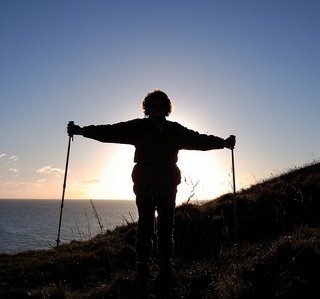
Ages: Colin was 61 years and 267 days. Rosemary was 59 years and 44 days.
Weather: Very grey and overcast with sleety showers and a cold wind. Persistent rain for the last four miles – not pleasant!
Location: Burnham Overy Staithe to Thornham.
Distance: 10 miles.
Total distance: 713½ miles.
Terrain: An icy road, a snowy field, grass banks & marshes, boardwalks which were glassy with ice, slippery icy snow & mud, and finally a wet road with traffic – not nice!
Tide: Out.
Rivers to cross: No.32, the Burn, at Burnham Overy Staithe.
Ferries: None.
Piers: None.
Kissing gates: No.84, at Brancaster.
Pubs: The ‘Jolly Sailor’ at Brancaster which, Colin was delighted to find, has been brewing its own beer since last November. We tried their IPA and ‘Old Les’.
‘English Heritage’ properties: None.
Diversions: None.
How we got there and back: We were staying with Paul and Caroline in Isleham, Cambridgeshire. We had driven up to the area yesterday, but discovered that the snowfall in North Norfolk had been much greater than further south. We had left late, because of the icy roads, and so we had missed the bus – but it didn’t run anyway because it couldn’t get up a hill. Besides, we felt that the walk would be hazardous with all that ice about – so we enjoyed the stunningly pretty villages in the snow and sunshine, visited the pub, did a lot of reccying, and went back. Today we drove up early on clear roads, parked in Thornham and caught the bus to Burnham Overy Staithe. We walked down a treacherously icy road by the waterfront to the spot where we had finished the last Walk.
At the end, we were soaking wet, cold and miserable. We had two cups of warming tea from our flask in the car, then drove back to Isleham without further delay. We do wonder about our sanity, sometimes!
I think we must have been mad to continue our trek on a day like today! It was freezing cold, wet and slippery underfoot. The sky was black and that turned into sleety showers before we had gone very far into the Walk. To crown it all, Colin’s coat zip got stuck and he couldn’t undo it! He had zipped it right up over his chin while we were waiting for the bus, which was late, and when he tried to lower it for comfort on the bus it wouldn’t move. I couldn’t get it to budge either—it must have come slightly off the end. He had to leave it like that for the whole Walk, moaning that he was too hot on the bus and that it rubbed his chin all the time he was walking along. The bus driver had been in a terrible mood, driving like the clappers on slippery roads whilst complaining loud and long about everyone and everything—I didn’t feel safe with him. As soon as we got off the bus it started raining, the first of the sleety showers. Not a good beginning to the day!
 We started at the wooden bench on the little quay. Someone had tipped it upside-down, I think it was to stop snow accumulating on it. We came out of the lane and walked along the side of the road to a windmill. It was the slipperiest conditions I have ever walked in—snow, ice and mud (along with the occasional dog shit) made for a hazardous hike. However, neither of us fell over! That was probably the only positive thing about today. We looked for a gap between the houses to take us to a footpath which runs behind them next to the marsh, but we couldn’t see one. Before the windmill, the path did go parallel to the road behind a hedge, but it was a bit slippery with ice and I wished I had stayed on the road with the traffic. At the windmill, the path went across a field to the marshes. We were pleased to find that it was relatively clear of snow and not too slippery, so we were able to walk at more of a pace.
There was a cold wind, so we were glad to walk faster! We did look to the right after a few yards to see a path snake off back to Burnham behind the houses, but it must have been a dead-end leading only to the marshes because we hadn’t seen any point where it could have come out in the village.
There wasn’t much scenery on our Walk today, but we did see a lot of birds—curlew, pewits, egrets, geese, oystercatchers, redshanks and other waders, and Colin was convinced he saw a snipe. There were also jet aircraft coming out of nowhere and zooming overhead with a great roar, so our Walk was far from peaceful. Over to our right, beyond the immediate marsh, was Scolt Head Island. The whole island is a nature reserve, and is all marshland. It is possible to walk over to it at low tide, but not recommended at this time of year! It is, apparently, quite bleak over there.
 We were pleased to approach Brancaster Staithe, if only to get out of the wind, but there the path got a lot more slippery so we had to slow our pace. We think people come out of the village to exercise their dogs, but only get a short way before they turn round—that is why we were slithering around. We got to the edge of civilisation, next to the path which leads out to Scolt Head Island, and sat down on a bank under a tree to eat our lunch. The ground was dry just where we were, and we were sheltered from the wind.
However, we didn’t linger. We continued along the backs of houses for about two miles to Brancaster. The footpath was obviously used by the people in the houses, and was all the more slippery for that. Where it was heavily walked, the snow had turned to ice making progress very difficult. Where they had put duckboards down because it was marshy, those were the worst areas. However, we both got through without incident. We passed some pools where the local fishermen wash mussels before selling them—I believe it is quite an industry round there. We also passed several interesting houses. One had a round tower with a weather vane on top, and another had sculpted herons on its gateposts.
At Brancaster we followed a road out to the edge of the marshes, and that is where it started to rain. The sky turned slate grey and it really set in. It poured for the rest of the Walk, and this put Colin in a foul mood, as if I wasn’t miserable enough! He flatly refused to put his overtrousers on because it would have meant taking his boots off—no! he hasn’t learnt from that dreadful walk we did from Caister to Horsey Gap back in September! I had to have a real go at him before he would stop moaning. I can’t seem to get it through to him that constant complaining only makes the situation worse because it puts everyone else involved in a bad mood too. You can’t improve a bad situation by remaining cheerful, but you can make those around you feel better. The day before I had photographed feathery reeds by the side of that road in brilliant sunshine, now they just looked sad.
 We could walk up on a bank alongside most of the road, and it wasn’t too slippery. We got to the public conveniences at the sea end, and they were actually open—well done Brancaster! Since it was the only place where we could get out of the rain, we both stood in the doorway of the ‘Ladies’ eating chocolate to give us the energy to complete our Walk in such dreadful conditions.
  I was amused by a sign on the road to the golf course (yes, they owned an ‘island’ in the middle of this prime marshland nature reserve) saying it was for ‘parishioners and hut owners only’! (I had photographed this the day before in brilliant sunshine – how I wished it would come back now!)
I insisted we stepped on to the beach because it was ages since we had seen the real sea. Colin just moaned and moaned, but I was saddened to read a memorial plaque to a child called Jake who drowned on 13th August 2000 on that beach. There was a poem to him, two of the lines read:
I couldn’t photograph the plaque because it was too wet to get my camera out. We found the path eastwards behind the dunes. It was fenced at first, and quite clear where it led, but then it petered out and it got very soggy underfoot. There was a track leading inland, but it was much too soon and would only have led us back to Brancaster. We got lost (and it was all my fault, of course) because the banks and dykes bore no relationship to those marked on the map. We crossed a ditch via a new bridge and then climbed on to a new bank, neither of which were marked on the map. I had to call Colin back because he had insisted on stomping off in the wrong direction.
We emerged on to the road, turned eastward and switched ourselves into ‘route-march’ mode. We stomped along in silence for two miles taking no notice of anything. We passed an ancient cross—didn’t even look at it. We walked through Titchwell village, and then passed the Titchwell Nature Reserve which we had visited the day before to enquire about the possibility of walking along the beach. There is a tidal inlet leading into the reserve, and our OS map shows the public footpath crossing this on the beach. The wardens told us that there was no way across it even at the lowest of tides, and that it was dangerous to attempt it—to tell the truth, I was mightily glad that I wasn’t on the beach in that weather! We passed some more fields, and at last we turned into Thornham village where our car was parked.
To complete the Walk properly, we needed to circuit round the north end of the village on a marsh path. It really wasn’t far, but it was already getting dark as we turned on to the path. We met a woman coming back into the village with her dog, who seemed surprised that we were going outwards in the damp and dark. “How brave of you to be going out there in this without a dog to take you!” she remarked—we couldn’t think of an answer to that! We trudged round in a semi-circle until we came to a little wooden bridge which led the coast path off towards Hunstanton.
That ended Walk no.94, we shall pick up Walk no.95 next time at the wooden bridge on the marsh path at the back of Thornham. We didn’t cross the bridge, but went straight on through the village to our car. Although we were soaking wet, cold and miserable, we did notice that all the snow and ice which had made the road and pavement so treacherous in the morning, had melted. Colin managed to remove his coat—with the zip still well and truly jammed—by pulling it over his head and me tugging on it. (I then checked that his ears were still in place because he wasn’t sure!) We had two cups of warming tea from our flask, then drove back to Isleham without further delay. Later that evening he managed to undo the zip after attacking it with a pair of pliers.
Weather: Very grey and overcast with sleety showers and a cold wind. Persistent rain for the last four miles – not pleasant!
Location: Burnham Overy Staithe to Thornham.
Distance: 10 miles.
Total distance: 713½ miles.
Terrain: An icy road, a snowy field, grass banks & marshes, boardwalks which were glassy with ice, slippery icy snow & mud, and finally a wet road with traffic – not nice!
Tide: Out.
Rivers to cross: No.32, the Burn, at Burnham Overy Staithe.
Ferries: None.
Piers: None.
Kissing gates: No.84, at Brancaster.
Pubs: The ‘Jolly Sailor’ at Brancaster which, Colin was delighted to find, has been brewing its own beer since last November. We tried their IPA and ‘Old Les’.
‘English Heritage’ properties: None.
Diversions: None.
How we got there and back: We were staying with Paul and Caroline in Isleham, Cambridgeshire. We had driven up to the area yesterday, but discovered that the snowfall in North Norfolk had been much greater than further south. We had left late, because of the icy roads, and so we had missed the bus – but it didn’t run anyway because it couldn’t get up a hill. Besides, we felt that the walk would be hazardous with all that ice about – so we enjoyed the stunningly pretty villages in the snow and sunshine, visited the pub, did a lot of reccying, and went back. Today we drove up early on clear roads, parked in Thornham and caught the bus to Burnham Overy Staithe. We walked down a treacherously icy road by the waterfront to the spot where we had finished the last Walk.
At the end, we were soaking wet, cold and miserable. We had two cups of warming tea from our flask in the car, then drove back to Isleham without further delay. We do wonder about our sanity, sometimes!
I think we must have been mad to continue our trek on a day like today! It was freezing cold, wet and slippery underfoot. The sky was black and that turned into sleety showers before we had gone very far into the Walk. To crown it all, Colin’s coat zip got stuck and he couldn’t undo it! He had zipped it right up over his chin while we were waiting for the bus, which was late, and when he tried to lower it for comfort on the bus it wouldn’t move. I couldn’t get it to budge either—it must have come slightly off the end. He had to leave it like that for the whole Walk, moaning that he was too hot on the bus and that it rubbed his chin all the time he was walking along. The bus driver had been in a terrible mood, driving like the clappers on slippery roads whilst complaining loud and long about everyone and everything—I didn’t feel safe with him. As soon as we got off the bus it started raining, the first of the sleety showers. Not a good beginning to the day!
 We started at the wooden bench on the little quay. Someone had tipped it upside-down, I think it was to stop snow accumulating on it. We came out of the lane and walked along the side of the road to a windmill. It was the slipperiest conditions I have ever walked in—snow, ice and mud (along with the occasional dog shit) made for a hazardous hike. However, neither of us fell over! That was probably the only positive thing about today. We looked for a gap between the houses to take us to a footpath which runs behind them next to the marsh, but we couldn’t see one. Before the windmill, the path did go parallel to the road behind a hedge, but it was a bit slippery with ice and I wished I had stayed on the road with the traffic. At the windmill, the path went across a field to the marshes. We were pleased to find that it was relatively clear of snow and not too slippery, so we were able to walk at more of a pace.
There was a cold wind, so we were glad to walk faster! We did look to the right after a few yards to see a path snake off back to Burnham behind the houses, but it must have been a dead-end leading only to the marshes because we hadn’t seen any point where it could have come out in the village.
There wasn’t much scenery on our Walk today, but we did see a lot of birds—curlew, pewits, egrets, geese, oystercatchers, redshanks and other waders, and Colin was convinced he saw a snipe. There were also jet aircraft coming out of nowhere and zooming overhead with a great roar, so our Walk was far from peaceful. Over to our right, beyond the immediate marsh, was Scolt Head Island. The whole island is a nature reserve, and is all marshland. It is possible to walk over to it at low tide, but not recommended at this time of year! It is, apparently, quite bleak over there.
 We were pleased to approach Brancaster Staithe, if only to get out of the wind, but there the path got a lot more slippery so we had to slow our pace. We think people come out of the village to exercise their dogs, but only get a short way before they turn round—that is why we were slithering around. We got to the edge of civilisation, next to the path which leads out to Scolt Head Island, and sat down on a bank under a tree to eat our lunch. The ground was dry just where we were, and we were sheltered from the wind.
However, we didn’t linger. We continued along the backs of houses for about two miles to Brancaster. The footpath was obviously used by the people in the houses, and was all the more slippery for that. Where it was heavily walked, the snow had turned to ice making progress very difficult. Where they had put duckboards down because it was marshy, those were the worst areas. However, we both got through without incident. We passed some pools where the local fishermen wash mussels before selling them—I believe it is quite an industry round there. We also passed several interesting houses. One had a round tower with a weather vane on top, and another had sculpted herons on its gateposts.

At Brancaster we followed a road out to the edge of the marshes, and that is where it started to rain. The sky turned slate grey and it really set in. It poured for the rest of the Walk, and this put Colin in a foul mood, as if I wasn’t miserable enough! He flatly refused to put his overtrousers on because it would have meant taking his boots off—no! he hasn’t learnt from that dreadful walk we did from Caister to Horsey Gap back in September! I had to have a real go at him before he would stop moaning. I can’t seem to get it through to him that constant complaining only makes the situation worse because it puts everyone else involved in a bad mood too. You can’t improve a bad situation by remaining cheerful, but you can make those around you feel better. The day before I had photographed feathery reeds by the side of that road in brilliant sunshine, now they just looked sad.
 We could walk up on a bank alongside most of the road, and it wasn’t too slippery. We got to the public conveniences at the sea end, and they were actually open—well done Brancaster! Since it was the only place where we could get out of the rain, we both stood in the doorway of the ‘Ladies’ eating chocolate to give us the energy to complete our Walk in such dreadful conditions.
  I was amused by a sign on the road to the golf course (yes, they owned an ‘island’ in the middle of this prime marshland nature reserve) saying it was for ‘parishioners and hut owners only’! (I had photographed this the day before in brilliant sunshine – how I wished it would come back now!)
I insisted we stepped on to the beach because it was ages since we had seen the real sea. Colin just moaned and moaned, but I was saddened to read a memorial plaque to a child called Jake who drowned on 13th August 2000 on that beach. There was a poem to him, two of the lines read:
One moment paddling happily,
The next he was gone!
I remember that incident when it was reported in the papers, but I thought it was two children, a brother and sister. (Perhaps there was another plaque nearby, but the weather was so awful, and so was Colin’s mood, that I didn’t see it.) The family came down on to the deserted beach on a beautiful Summer’s day, having never been there before and knowing nothing about the local currents and tides. The children changed, and rushed down to the water. Their parents sorted out their belongings and followed them, but they couldn’t see them. Their little bodies were washed up days later—it was assumed that they ran into the water and got swept away almost immediately. Their parents were distraught, but it was just a tragic accident.The next he was gone!
I couldn’t photograph the plaque because it was too wet to get my camera out. We found the path eastwards behind the dunes. It was fenced at first, and quite clear where it led, but then it petered out and it got very soggy underfoot. There was a track leading inland, but it was much too soon and would only have led us back to Brancaster. We got lost (and it was all my fault, of course) because the banks and dykes bore no relationship to those marked on the map. We crossed a ditch via a new bridge and then climbed on to a new bank, neither of which were marked on the map. I had to call Colin back because he had insisted on stomping off in the wrong direction.
We emerged on to the road, turned eastward and switched ourselves into ‘route-march’ mode. We stomped along in silence for two miles taking no notice of anything. We passed an ancient cross—didn’t even look at it. We walked through Titchwell village, and then passed the Titchwell Nature Reserve which we had visited the day before to enquire about the possibility of walking along the beach. There is a tidal inlet leading into the reserve, and our OS map shows the public footpath crossing this on the beach. The wardens told us that there was no way across it even at the lowest of tides, and that it was dangerous to attempt it—to tell the truth, I was mightily glad that I wasn’t on the beach in that weather! We passed some more fields, and at last we turned into Thornham village where our car was parked.
To complete the Walk properly, we needed to circuit round the north end of the village on a marsh path. It really wasn’t far, but it was already getting dark as we turned on to the path. We met a woman coming back into the village with her dog, who seemed surprised that we were going outwards in the damp and dark. “How brave of you to be going out there in this without a dog to take you!” she remarked—we couldn’t think of an answer to that! We trudged round in a semi-circle until we came to a little wooden bridge which led the coast path off towards Hunstanton.
That ended Walk no.94, we shall pick up Walk no.95 next time at the wooden bridge on the marsh path at the back of Thornham. We didn’t cross the bridge, but went straight on through the village to our car. Although we were soaking wet, cold and miserable, we did notice that all the snow and ice which had made the road and pavement so treacherous in the morning, had melted. Colin managed to remove his coat—with the zip still well and truly jammed—by pulling it over his head and me tugging on it. (I then checked that his ears were still in place because he wasn’t sure!) We had two cups of warming tea from our flask, then drove back to Isleham without further delay. Later that evening he managed to undo the zip after attacking it with a pair of pliers.