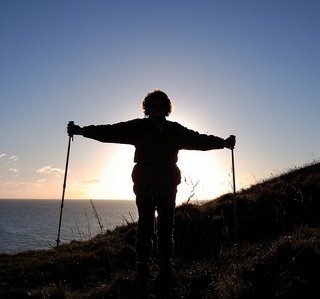
Ages: Colin was 63 years and 18 days. Rosemary was 60 years and 160 days.
Weather: Soft cloud, clearing to a hot sun. A warm wind from behind.
Location: Skegness to Anderby Creek.
Distance: 8½ miles.
Total distance: 822 miles.
Terrain: Some beach where the sand was a bit sinky. Mostly concrete walkways, occasionally covered in soft-blown sand.
Tide: Out.
Rivers: None.
Ferries: None.
Piers: No. 24, Skegness.
Kissing gates: None.
Pubs: None. (Colin is very scathing about seaside bars that ‘only serve keg’!)
'English Heritage’ properties: None.
Ferris wheels: No.3, at Ingoldmells in a theme park called ‘Fantasy Island’. It claims to be the biggest in Europe, but it was closed because of the wind!
Diversions: None.
How we got there and back: We drove up the day before and set up camp at Anderby. It was only a mile from Anderby Creek car park (free!) where we took the bikes on the back of the car. Then we cycled to Skegness where we padlocked our bikes to a proper cycle rack.
At the end, we had a cup of tea, then Colin drove me back to the campsite so that I could get on with cooking the dinner. Meanwhile, he drove down to Skegness and collected the bikes.
Eleven months! I was determined to get us back on track, before we got too old to be capable of completing this trek which I have reckoned will take us a total of twenty-five years. (That would make Colin 81 and me 78 when we finish!) So why eleven months? We were exhausted and miserable when we got back from Walk 104 for all the reasons previously explained. Colin had been trying very hard not to get depressed about his incontinence but it was dreadfully awkward and embarrassing at times, particularly as he is such an active person. He tried to think positively, empathising with friends who are battling with prostate cancer, but it was difficult. The urine didn’t just seep out, it gushed at times and he had absolutely no control.
Then there was our house move. We have planned for years to retire to Yorkshire, but we don’t seem to be getting on with it at all. The main problem is Colin’s clutter—and I am talking clutter big time here, like eight motor bikes in bits, several canoes, a shed, garage and large bedroom so full that you can hardly squeeze in through the door, and much more! Colin is a hoarder—he never throws anything away and we have lived in this house for twenty-seven years!
Bognor used to be a nice place to live, but now it is seedy. There are plans to build sixteen hundred new houses—not new roads, schools, clinics, community centres or shops—just houses, houses, houses. Plans have been thrown out, but they keep coming back and they will build them—we have no doubt.
A new neighbour moved into the bottom flat of the house next door, and he was bad news from day one. Noisy, loud, swearing, parties, thumping pop-music, vans and cars parked all over the place (several of them untaxed), and a whole series of horrible ‘friends’ and hangers-on. Fights in the back garden in the middle of the night, holes made in our front hedge where they also left their beer cans after consuming the contents in the street, and rubbish, rubbish everywhere—mostly dog-ends and empty cigarette packets.
I was desperate to put the house up for sale and get out. Colin said he couldn’t get on with ‘sorting’ his clutter (why not just take it all to the tip?) because we kept going away. So I agreed to put the Round-Britain-Walk on hold to allow him time. Effectively he did nothing! After eleven months he had sold a few items, moved a lot more from one side of the room to the other, but the only time he did go to the tip with a car load he got a puncture because he drove over a nail! He was still going on his beer trips, I was getting more and more miserable because I so wanted to get on with the trek, and we were no nearer moving house than we had been before!
During the Summer of 2004 Collin went for a lot of rather unpleasant tests at the hospital to find out if his condition could be improved by inserting an artificial sphincter round the neck of his bladder. One or two of his subsequent appointments were a complete and utter waste of time because the only surgeon who knew anything about this pioneering operation wasn’t always there, and her underlings knew less about it than Colin did! In early October he was at last told that he was a suitable candidate for this particular operation, but he would have to wait six months. Why? That’s our National Health Service for you!
He was given a date at the beginning of April 2005. He couldn’t wait! Despite being warned that it was a major operation, he didn’t find it nearly as bad as the prostatectomy he had undergone eighteen months before. He was put in a private room because there was a very real danger of infection, and sent home after only 48 hours. He didn’t get an infection and healed up very quickly indeed, but he had to wait a further seven weeks before they would switch the device on. It worked!! He now has 95% control of his bladder, instead of the mere 5% he had before. He was over the moon, life could return to normal. We agreed to resume the Round-Britain-Walk immediately.

 One more thing. In December 2004, I turned 60 and officially became an OAP. I knew I had gradually been putting on weight over the years, and usually dismissed it because I am ‘getting old’. That Christmas I measured my BMI (Body-Mass-Index) and found it to be 29.9—only 0.1 of a point off being clinically obese! No!!! That is not the way I want to go! So, on 1st January 2005 Colin and I started a ‘food-combining’ diet—he said he would keep me company because it would make meals a lot easier, and anyway he needed to lose a few pounds too.
  The weight just started to fall off! In five months I have lost over a stone and brought my BMI down to 27.4! Colin lost his extra pounds too, and then he started ‘cheating’—but that doesn’t matter because he doesn’t need to lose any more. We have neither of us been hungry, except just before a meal. We haven’t had to give up any of the foods we like, just separate our proteins and carbohydrates. It is a new way of eating, and I have been experimenting with lots of new and exciting recipes. I really love my food now, it is not the slightest bit boring, and we haven’t had to give up our beer, cider or wine. Not only that, I feel a lot more energetic and healthier than I have ever been in my life! I can’t believe I’m an OAP, though the pension does come in very handy!

 Now to the Walk. First I will talk about Skegness where we spent a couple of hours on one of our ‘rest’ days. When we were here nearly a year ago, what struck us most was the number of obese people of all ages walking the streets. Then we were tired, wet, cold and miserable—this year we are energetic, dry, warm and cheerful. Skegness hasn’t changed, it is still full of hopelessly obese people! Perhaps I am more aware of them now, since I have so successfully lost weight, but I really don’t know how some of the worst cases can allow themselves to get like that. Measuring my BMI was my ‘wake-up call’, I was always so skinny as a child.
 A recent item on the News (it must have been a ‘low-news’ day) said that Skegness was the ideal town in Britain to retire to. This is because it is flat, has a nice promenade by the sea and lots of Bingo houses where the Wrinklies can go to enjoy themselves. (Why do they think that people lose their intelligence just because they are old?) They didn’t mention the cold east wind, the featureless landscape, the greasy fish ’n’ chip shops nor the crowds of fat people! Colin was equally disappointed this year. He remembered the dancing fisherman statue and the beautiful sandy beach —
 I’ll give you that, the beach is lovely — but not much else because he was very young when he used to come here with his parents.
  He couldn’t remember where he stayed, or anything else about the place much at all. He concluded that it has probably changed a lot over the past 50+ years, and I could tell he was rather disillusioned. He didn’t even take any notice of a fat girl showing her knickers on the beach!
The Ferris wheel was going! We bought enough tokens for three rides, then we went on it together taking photos of each other and of the view. Then I stayed on for an extra ride while Colin took photos of me up there. It was very exciting—is that what they meant when they said ‘Skeggie’ was an ideal place for OAPs? (Colin thinks I am a nutcase!)


 Now for the real Walk! We padlocked our bikes to the railings near the pier because we wanted to start there. It is very short, doesn’t even reach the sea, but then the tide was out. It also isn’t very high, when we later wheeled our bikes under it we had to crouch. It looked very new, and we wondered if it was a millennium project like Southwold Pier.
  Colin said he couldn’t remember there being a pier when he visited as a child. At the shore end there is a kiosk which says, “Next stop Hunstanton” with an arrow pointing to the sea end. This is really the end of walking round ‘The Wash’ (thank goodness!) so I stood on the end of the pier pointing towards Hunstanton —
 just as I had stood in Hunstanton sixteen months ago and pointed through the mist towards Skegness. Only today it was clearer, and we could just make out the Norfolk coast on the horizon.
We pushed our bikes to a car park at the northern end of the resort and padlocked them to a post because it would be easier to pick them up from there at the end of the day. The concrete walkway continued for miles, which made walking a lot easier even though it was occasionally covered in soft-blown sand.
 We passed a school party sitting on the edge of the prom eating their lunch, and I couldn’t resist a smirk because I no longer have to cope with the responsibility of looking after other people’s children. However, these quite little kids were really very well behaved, and further on we looked back to see them all happily paddling in the edge of the sea.
 We thought the warning notices on the railings were a little OTT. Is it really necessary to state the obvious—that open water and the sea can actually be quite dangerous if you are stupid? Whatever happened to common sense? Perhaps it has something to do with the plethora of ‘Fish ’n’ chips’ and ‘Happy hour’ establishments we passed along the way. I do believe that diet has a lot to do with intelligence.
As we made our way northwards, a number of features of interest caught our notice. Bunches of flowers tied to a fence. Why? They seemed to be in memory of someone’s Grandma, but we didn’t think she had actually died at that spot. Everywhere we go these days there seems to be bunches of flowers left about because someone has died. Bereavement is a difficult thing to cope with, but we fail to see how leaving bunches of flowers about helps you through it, particularly as the flowers—rarely in water—die within a few hours leaving brown straggly bits wrapped in ugly cellophane. Surely it is better to remember the good times and move on. Flowers are not going to bring the dead back, only give the flower shops a good trade! Flowers for the living, yes, because it cheers up the recipient, but flowers for the dead I have never understood.
 We passed a single-storied flat-roofed house with an interesting external staircase, and further on a miners’ convalescent home. We wondered what it was used for now because there aren’t any miners left in this country, are there?
 We sat on a breakwater to eat the first part of our lunch, and as we moved on the weather got hotter. We were glad of a slight breeze along the shore. The beach got lonelier, with small dunes next to the concrete walkway and very few people. No one walks between resorts like we do! Soon we passed the original Butlin’s holiday camp—the very first to be built in the 1930s. I have given the history of Butlin’s in the chapter for Walk 74 when we passed Clacton, the site of the second camp to be built. Unlike Clacton, Skegness has survived into the 21st century. It has been renamed, refurbished and reinvented—and there it was, under an inverted cow’s udder just like the one at Bognor!
  Their access to the beach was busy, mostly with obese people, and we could hear a loudspeaker inside the big white tent where everyone was (supposedly) having a wonderful time!
  But we couldn’t fathom the significance of the American flags flying on the prom just there.
Butlins may have been open and running, but it is now dwarfed by ‘Fantasy Island’, a modern funfair with all the latest stomach-churning rides that are guaranteed to make you sick! The Ferris wheel is HUGE, but is nearly always closed because of the wind. It takes intelligence—she says sarcastically—to build such a large and flimsy structure in one of the windiest places in Britain.
 (Sorry to be so cynical—but it does seem daft!) I never got a ride on it because it was closed all the while we were there. The whole area is a marsh, too, with acres upon acres of caravans. As we passed Ingoldmells Point we looked over at the main drain, and it didn’t look attractive in the least. No, Skegness is not a place I would be happy to retire to!
 We sat on some beach steps there to eat the second half of our lunch, and idly watched a tractor mooching up and down ‘combing’ the sands.
  The beach didn’t look much different after he had passed, we wondered if it was worthwhile him doing it. Again we lost the crowds after we had passed all the holiday camps, and didn’t pick them up again until we approached Chapel St Leonards, despite passing wall-to-wall caravans. Few of them seemed to be occupied, yet we are almost on the busiest bank-holiday weekend of the year.
 Colourful beach huts marked our approach to Chapel St Leonards, then the familiar smell of greasy fat and “ping-pong-ping” sounds of the local amusement arcade. There seemed to be a desperation to get us to stop and eat their awful food—first we passed a sign reading, “2 meals for £6.95!” Then it was, “2 meals for £5.95!” Finally, at the very last establishment we passed, it was, “2 meals for £5.50!” We didn’t take any of them up, instead we sat in a rather nice log-cabin style gazebo on the Point and ate our chocolate to give us an energy boost for the final fling.
After that the concrete prom ran out, so we had to resort to the beach. Fortunately the sand was fairly firm below high water mark, though a bit too soft amongst the dunes. Since the tide was out, it was really quite enjoyable walking the last couple of miles to Anderby Creek. There we had a little bit of difficulty locating the correct path through the dunes, but we soon found it and cut through to the free car park with toilets—where our car was waiting for us—past a new beach shelter with a ‘round window’!
 That ended Walk no.105, we shall pick up Walk no.106 next time on the beach at Anderby Creek. After we had enjoyed a cup of tea, Colin drove me the short distance back to the campsite so that I could get on with cooking the dinner. Meanwhile, he drove down to Skegness and collected the bikes.
Weather: Soft cloud, clearing to a hot sun. A warm wind from behind.
Location: Skegness to Anderby Creek.
Distance: 8½ miles.
Total distance: 822 miles.
Terrain: Some beach where the sand was a bit sinky. Mostly concrete walkways, occasionally covered in soft-blown sand.
Tide: Out.
Rivers: None.
Ferries: None.
Piers: No. 24, Skegness.
Kissing gates: None.
Pubs: None. (Colin is very scathing about seaside bars that ‘only serve keg’!)
'English Heritage’ properties: None.
Ferris wheels: No.3, at Ingoldmells in a theme park called ‘Fantasy Island’. It claims to be the biggest in Europe, but it was closed because of the wind!
Diversions: None.
How we got there and back: We drove up the day before and set up camp at Anderby. It was only a mile from Anderby Creek car park (free!) where we took the bikes on the back of the car. Then we cycled to Skegness where we padlocked our bikes to a proper cycle rack.
At the end, we had a cup of tea, then Colin drove me back to the campsite so that I could get on with cooking the dinner. Meanwhile, he drove down to Skegness and collected the bikes.
Eleven months! I was determined to get us back on track, before we got too old to be capable of completing this trek which I have reckoned will take us a total of twenty-five years. (That would make Colin 81 and me 78 when we finish!) So why eleven months? We were exhausted and miserable when we got back from Walk 104 for all the reasons previously explained. Colin had been trying very hard not to get depressed about his incontinence but it was dreadfully awkward and embarrassing at times, particularly as he is such an active person. He tried to think positively, empathising with friends who are battling with prostate cancer, but it was difficult. The urine didn’t just seep out, it gushed at times and he had absolutely no control.
Then there was our house move. We have planned for years to retire to Yorkshire, but we don’t seem to be getting on with it at all. The main problem is Colin’s clutter—and I am talking clutter big time here, like eight motor bikes in bits, several canoes, a shed, garage and large bedroom so full that you can hardly squeeze in through the door, and much more! Colin is a hoarder—he never throws anything away and we have lived in this house for twenty-seven years!
Bognor used to be a nice place to live, but now it is seedy. There are plans to build sixteen hundred new houses—not new roads, schools, clinics, community centres or shops—just houses, houses, houses. Plans have been thrown out, but they keep coming back and they will build them—we have no doubt.
A new neighbour moved into the bottom flat of the house next door, and he was bad news from day one. Noisy, loud, swearing, parties, thumping pop-music, vans and cars parked all over the place (several of them untaxed), and a whole series of horrible ‘friends’ and hangers-on. Fights in the back garden in the middle of the night, holes made in our front hedge where they also left their beer cans after consuming the contents in the street, and rubbish, rubbish everywhere—mostly dog-ends and empty cigarette packets.
I was desperate to put the house up for sale and get out. Colin said he couldn’t get on with ‘sorting’ his clutter (why not just take it all to the tip?) because we kept going away. So I agreed to put the Round-Britain-Walk on hold to allow him time. Effectively he did nothing! After eleven months he had sold a few items, moved a lot more from one side of the room to the other, but the only time he did go to the tip with a car load he got a puncture because he drove over a nail! He was still going on his beer trips, I was getting more and more miserable because I so wanted to get on with the trek, and we were no nearer moving house than we had been before!
During the Summer of 2004 Collin went for a lot of rather unpleasant tests at the hospital to find out if his condition could be improved by inserting an artificial sphincter round the neck of his bladder. One or two of his subsequent appointments were a complete and utter waste of time because the only surgeon who knew anything about this pioneering operation wasn’t always there, and her underlings knew less about it than Colin did! In early October he was at last told that he was a suitable candidate for this particular operation, but he would have to wait six months. Why? That’s our National Health Service for you!
He was given a date at the beginning of April 2005. He couldn’t wait! Despite being warned that it was a major operation, he didn’t find it nearly as bad as the prostatectomy he had undergone eighteen months before. He was put in a private room because there was a very real danger of infection, and sent home after only 48 hours. He didn’t get an infection and healed up very quickly indeed, but he had to wait a further seven weeks before they would switch the device on. It worked!! He now has 95% control of his bladder, instead of the mere 5% he had before. He was over the moon, life could return to normal. We agreed to resume the Round-Britain-Walk immediately.

 One more thing. In December 2004, I turned 60 and officially became an OAP. I knew I had gradually been putting on weight over the years, and usually dismissed it because I am ‘getting old’. That Christmas I measured my BMI (Body-Mass-Index) and found it to be 29.9—only 0.1 of a point off being clinically obese! No!!! That is not the way I want to go! So, on 1st January 2005 Colin and I started a ‘food-combining’ diet—he said he would keep me company because it would make meals a lot easier, and anyway he needed to lose a few pounds too.
  The weight just started to fall off! In five months I have lost over a stone and brought my BMI down to 27.4! Colin lost his extra pounds too, and then he started ‘cheating’—but that doesn’t matter because he doesn’t need to lose any more. We have neither of us been hungry, except just before a meal. We haven’t had to give up any of the foods we like, just separate our proteins and carbohydrates. It is a new way of eating, and I have been experimenting with lots of new and exciting recipes. I really love my food now, it is not the slightest bit boring, and we haven’t had to give up our beer, cider or wine. Not only that, I feel a lot more energetic and healthier than I have ever been in my life! I can’t believe I’m an OAP, though the pension does come in very handy!
 Now to the Walk. First I will talk about Skegness where we spent a couple of hours on one of our ‘rest’ days. When we were here nearly a year ago, what struck us most was the number of obese people of all ages walking the streets. Then we were tired, wet, cold and miserable—this year we are energetic, dry, warm and cheerful. Skegness hasn’t changed, it is still full of hopelessly obese people! Perhaps I am more aware of them now, since I have so successfully lost weight, but I really don’t know how some of the worst cases can allow themselves to get like that. Measuring my BMI was my ‘wake-up call’, I was always so skinny as a child.
 A recent item on the News (it must have been a ‘low-news’ day) said that Skegness was the ideal town in Britain to retire to. This is because it is flat, has a nice promenade by the sea and lots of Bingo houses where the Wrinklies can go to enjoy themselves. (Why do they think that people lose their intelligence just because they are old?) They didn’t mention the cold east wind, the featureless landscape, the greasy fish ’n’ chip shops nor the crowds of fat people! Colin was equally disappointed this year. He remembered the dancing fisherman statue and the beautiful sandy beach —
 I’ll give you that, the beach is lovely — but not much else because he was very young when he used to come here with his parents.
  He couldn’t remember where he stayed, or anything else about the place much at all. He concluded that it has probably changed a lot over the past 50+ years, and I could tell he was rather disillusioned. He didn’t even take any notice of a fat girl showing her knickers on the beach!
The Ferris wheel was going! We bought enough tokens for three rides, then we went on it together taking photos of each other and of the view. Then I stayed on for an extra ride while Colin took photos of me up there. It was very exciting—is that what they meant when they said ‘Skeggie’ was an ideal place for OAPs? (Colin thinks I am a nutcase!)


 Now for the real Walk! We padlocked our bikes to the railings near the pier because we wanted to start there. It is very short, doesn’t even reach the sea, but then the tide was out. It also isn’t very high, when we later wheeled our bikes under it we had to crouch. It looked very new, and we wondered if it was a millennium project like Southwold Pier.
  Colin said he couldn’t remember there being a pier when he visited as a child. At the shore end there is a kiosk which says, “Next stop Hunstanton” with an arrow pointing to the sea end. This is really the end of walking round ‘The Wash’ (thank goodness!) so I stood on the end of the pier pointing towards Hunstanton —
 just as I had stood in Hunstanton sixteen months ago and pointed through the mist towards Skegness. Only today it was clearer, and we could just make out the Norfolk coast on the horizon.
We pushed our bikes to a car park at the northern end of the resort and padlocked them to a post because it would be easier to pick them up from there at the end of the day. The concrete walkway continued for miles, which made walking a lot easier even though it was occasionally covered in soft-blown sand.
 We passed a school party sitting on the edge of the prom eating their lunch, and I couldn’t resist a smirk because I no longer have to cope with the responsibility of looking after other people’s children. However, these quite little kids were really very well behaved, and further on we looked back to see them all happily paddling in the edge of the sea.
 We thought the warning notices on the railings were a little OTT. Is it really necessary to state the obvious—that open water and the sea can actually be quite dangerous if you are stupid? Whatever happened to common sense? Perhaps it has something to do with the plethora of ‘Fish ’n’ chips’ and ‘Happy hour’ establishments we passed along the way. I do believe that diet has a lot to do with intelligence.
As we made our way northwards, a number of features of interest caught our notice. Bunches of flowers tied to a fence. Why? They seemed to be in memory of someone’s Grandma, but we didn’t think she had actually died at that spot.
 Everywhere we go these days there seems to be bunches of flowers left about because someone has died. Bereavement is a difficult thing to cope with, but we fail to see how leaving bunches of flowers about helps you through it, particularly as the flowers—rarely in water—die within a few hours leaving brown straggly bits wrapped in ugly cellophane. Surely it is better to remember the good times and move on. Flowers are not going to bring the dead back, only give the flower shops a good trade! Flowers for the living, yes, because it cheers up the recipient, but flowers for the dead I have never understood.
 We passed a single-storied flat-roofed house with an interesting external staircase, and further on a miners’ convalescent home. We wondered what it was used for now because there aren’t any miners left in this country, are there?
 We sat on a breakwater to eat the first part of our lunch, and as we moved on the weather got hotter. We were glad of a slight breeze along the shore. The beach got lonelier, with small dunes next to the concrete walkway and very few people. No one walks between resorts like we do! Soon we passed the original Butlin’s holiday camp—the very first to be built in the 1930s. I have given the history of Butlin’s in the chapter for Walk 74 when we passed Clacton, the site of the second camp to be built. Unlike Clacton, Skegness has survived into the 21st century. It has been renamed, refurbished and reinvented—and there it was, under an inverted cow’s udder just like the one at Bognor!
  Their access to the beach was busy, mostly with obese people, and we could hear a loudspeaker inside the big white tent where everyone was (supposedly) having a wonderful time!
  But we couldn’t fathom the significance of the American flags flying on the prom just there.
Butlins may have been open and running, but it is now dwarfed by ‘Fantasy Island’, a modern funfair with all the latest stomach-churning rides that are guaranteed to make you sick! The Ferris wheel is HUGE, but is nearly always closed because of the wind. It takes intelligence—she says sarcastically—to build such a large and flimsy structure in one of the windiest places in Britain.
 (Sorry to be so cynical—but it does seem daft!) I never got a ride on it because it was closed all the while we were there. The whole area is a marsh, too, with acres upon acres of caravans. As we passed Ingoldmells Point we looked over at the main drain, and it didn’t look attractive in the least. No, Skegness is not a place I would be happy to retire to!
 We sat on some beach steps there to eat the second half of our lunch, and idly watched a tractor mooching up and down ‘combing’ the sands.
  The beach didn’t look much different after he had passed, we wondered if it was worthwhile him doing it. Again we lost the crowds after we had passed all the holiday camps, and didn’t pick them up again until we approached Chapel St Leonards, despite passing wall-to-wall caravans. Few of them seemed to be occupied, yet we are almost on the busiest bank-holiday weekend of the year.
 Colourful beach huts marked our approach to Chapel St Leonards, then the familiar smell of greasy fat and “ping-pong-ping” sounds of the local amusement arcade. There seemed to be a desperation to get us to stop and eat their awful food—first we passed a sign reading, “2 meals for £6.95!” Then it was, “2 meals for £5.95!” Finally, at the very last establishment we passed, it was, “2 meals for £5.50!” We didn’t take any of them up, instead we sat in a rather nice log-cabin style gazebo on the Point and ate our chocolate to give us an energy boost for the final fling.
After that the concrete prom ran out, so we had to resort to the beach. Fortunately the sand was fairly firm below high water mark, though a bit too soft amongst the dunes. Since the tide was out, it was really quite enjoyable walking the last couple of miles to Anderby Creek. There we had a little bit of difficulty locating the correct path through the dunes, but we soon found it and cut through to the free car park with toilets—where our car was waiting for us—past a new beach shelter with a ‘round window’!
 That ended Walk no.105, we shall pick up Walk no.106 next time on the beach at Anderby Creek. After we had enjoyed a cup of tea, Colin drove me the short distance back to the campsite so that I could get on with cooking the dinner. Meanwhile, he drove down to Skegness and collected the bikes.